
Blog · 24 October 2026 · Alex Barakov
Product builders: no results yet.
In 2026 tech companies are piloting a new role: the product builder. One person comes up with a feature, designs it and builds it with AI agents, work that used to take a product manager, a designer and several engineers. Five companies have said in articles, podcasts and other open sources what came of it: more code, little of it reaching users, and nobody has measured the effect on the business yet.
The point
+220%
code changes in Meta's internal systems in a year
+36%
changes that users actually saw
Meta internal data, published by Reuters, 2026
- Some developers, product managers and analysts become builders. The other roles become their support: data, review, hard cases, the platform.
- Delivery really is speeding up: code gets written faster, and everyone notices. Quality and reliability lag behind: rollbacks, outages and tech debt grow. Discovery and analytics are not speeding up yet, and teams end up with empty backlogs. Analytics gets done partly or skipped.
- Nobody has measured the effect on the business.
Five pilots
Who tried it and what came out
Only companies that described how they set up the pilot and what came out of it are listed here. LinkedIn, Coinbase, Block and Ramp announced programmes but showed no results. OpenAI's Harness team simply grew from 3 to 7 engineers, which is not a builder pilot. So none of them are here.
Before
A team of 10–20: engineers, a product manager, a designer, an analyst, a researcher, a data engineer
After
A group of 3–5: 3–4 builders, usually former engineers, and one person who decides what to build. Designers and analysts sit in a shared team across groups
Meta's internal slide, published by Reuters
| Company | Outcome | What they did | What came out | Source |
|---|---|---|---|---|
| Meta | Partly rolled back |
|
| Source ↗ |
| Atlassian | Rolled back |
|
| Source ↗ |
| Intercom | Outcome unknown |
|
| Source ↗ |
| epilot | Continuing with limits |
|
| Source ↗ |
| Uber | Outcome unknown |
|
| Source ↗ |
- MetaPartly rolled back
What they did
- Groups of 3–5 instead of teams of 10–20
- ~1,000 people from Reality Labs, the VR and AR division
What came out
- Code +220%, changes for users +36%
- Major outages +40%
- AtlassianRolled back
What they did
- ~10 projects of selected builders
- Product managers, designers and engineers in one role
What came out
- Fast first weeks, then a sharp slowdown
- No figures published
- IntercomOutcome unknown
What they did
- ~500 people in R&D
- 94% of code changes created by an agent, designers ship their own fixes
What came out
- Three times the changes per person in 16 months
- Bug queue −54%, idea to release −39%
- epilotContinuing with limits
What they did
- A German B2B software company. For 60 days, 50+ people outside engineering got access to code
What came out
- 40 of 629 changes came from 11 people outside engineering
- One change reached production past the automatic checks
- UberOutcome unknown
What they did
- A year of product managers prototyping with AI
What came out
- “Two hours of prototyping replaced four weeks of discussion”
- Prototypes get taken for the finished solution
“Outcome unknown” means the company has not said whether it met its goal.
What breaks
Four problems that keep coming back
More code, same value
+30%
code after AI agents, Harvard, 718 companies
- Finished tasks did not grow
- At Meta changes for users +36% against code +220%
Nobody decides what to build
1 : 30–40
one product manager or designer per 30–40 engineers, as Atlassian's teams felt it
- Everyone went off to write code, nobody set the direction
- It used to be 1 to 10. The pilot was rolled back
Review cannot keep up
+40%
- Firefighting time +70%
- Intercom: code review became the bottleneck, quality dipped
People burn out
74% → 55%
- Former managers asked to come back to management
My observations
Analytics falls behind
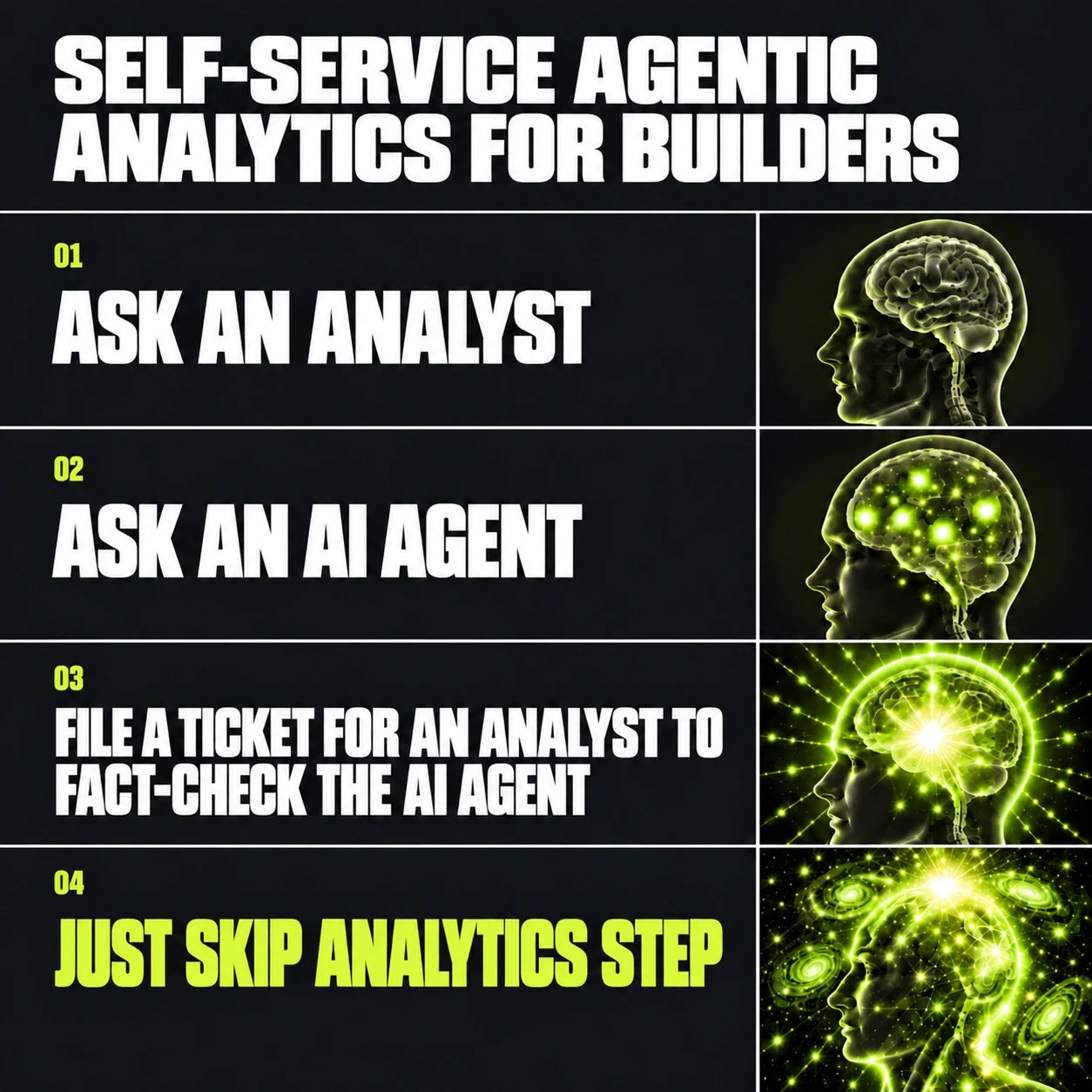
Features ship faster than anyone checks whether they worked. I see three reasons: builders lack the skill, they would rather not dig in themselves, and the agent has nothing to stand on.
Analytics gets done halfway
A builder ships a feature and does not check whether it helped. When they run an A/B test, they often cannot set it up or read it properly.
Builders don't want to do it
Builders do not want to dig into data themselves and go to an analyst. The load on analysts does not drop.
The agent has nothing to stand on
Without instructions and shared metric definitions the agent writes queries from scratch, numbers disagree, and the builder goes back to an analyst.
Code and interfaces
Code gets sloppy, debt piles up
Tests, docs and clean-up are skipped for speed. Six months to a year later, every change takes longer and costs more.
Products look alike
Agents build interfaces from the same templates. Nobody thinks about whether the product is easy to use.
Roles
Who moves where
My generalised scenario from the pilots. Some developers, product managers and analysts become builders. Every role becomes support for builders. No company has gone all the way.
What changes in each role
- Developer
- Writing codeGiving the agent tasks and checking its code. Plus part of the product job (what to build and why) and of the analyst's (checking whether a feature worked)
- Product
- Mock-ups, simple featuresDeciding what to build and in what order, talking to customers. Plus part of the developer's job (building a feature with the agent) and of the analyst's (running a simple test, reading a metric)
- Analyst (DA, DS)
- SQL, routine pulls, simple A/B testsComplex tests and research, teaching other roles their skills
- BI/AE/DE
- Building metrics, data marts, dashboards, pipelines from templatesRunning the domain knowledge base and shared metric definitions for the agent (semantic layer), checking its answers (evals), owning which data is right, keeping an eye on what builders make
Builders team
ships features with agents
Who
Some developers, product managers and analysts
What they do
Come up with a feature, design it and build it. The agent writes the code, queries and prototypes
Support for builders
enablement
Who
Every role: BI, AE and DE, designers, and the developers, product managers and analysts who did not become builders
What they do
Keep builders from breaking things: data and metrics the agent can trust, checks of its answers, the platform, a shared set of interface elements, training
People
Who becomes a builder
Product managers and analysts are easier to retrain: they learn to code with an agent quickly. Thinking about the business and making decisions are harder to teach.
What happens to newcomers
If you run a pilot
What to measure
Artefacts: is there an effect
Look at what builders made: features, tests, reports. Did it reach users and move a metric.
Logs: are there attempts
Who tries to do the task themselves with the agent, how often, and at which step they give up and go to a specialist.
Barriers: what fails in the agents
Why the job someone came to the agent for (JTBD) was not done: no data or access, a wrong answer, a missing skill.
If you run a builder pilot and measure its effect, tell me how.
Sources
- Meta — Reuters investigation, 26.08.2026 (syndicated copy)
- Meta — Scaling AI-native analytics patterns, 20.10.2026
- Meta — Sundial acquisition, Axios, 23.10.2026
- Atlassian — The future of product craft, 28.05.2026
- Atlassian — SaaStr session recap
- Intercom — 2× nine months later, 16.04.2026
- Intercom — Webinar Q&A: how Fin 3x'd R&D output
- Intercom — Every business leader deserves their own data analyst, 10.04.2026
- Intercom — Nobody changed their title, 07.07.2026
- Intercom — How eight people hold the bar for 200+ builders, 09.07.2026
- epilot — 40 PRs from non-engineers in 60 days
- Uber — AI prototyping is changing how we build products, 15.04.2026
- Chen & Stratton, Harvard working paper, 04.08.2026 (summary)
- Bain — The half-finished redesign, Technology Report 2026
- HBS and P&G — The Cybernetic Teammate, NBER w33641
- Anthropic — Self-service data analytics with Claude, 03.06.2026
- Booking.com — Scaling experimentation quality, 24.03.2026
- Ramp — Meet Ramp Research