
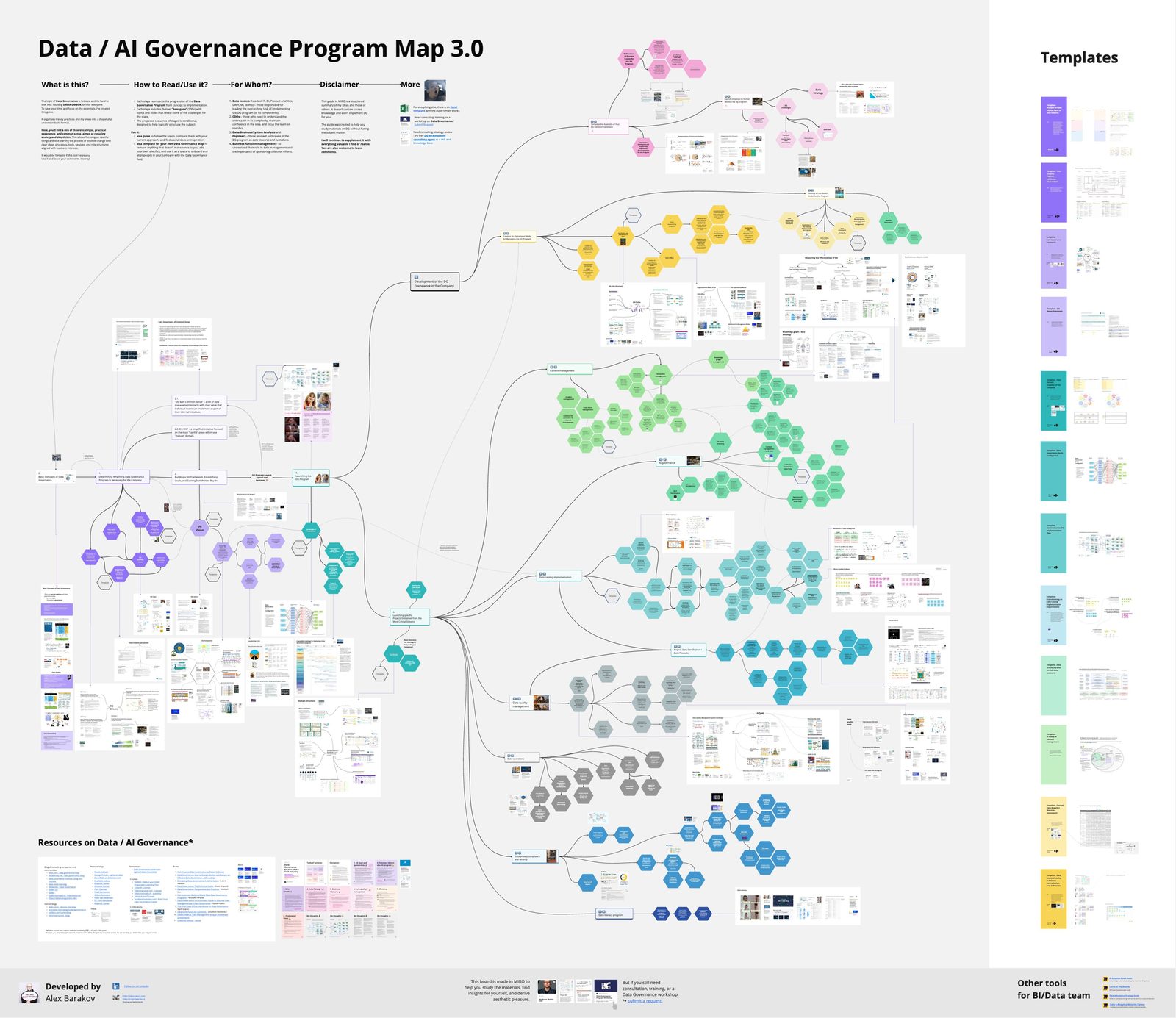
DG discovery instead of reading DAMA-DMBOK
When I drew the first version of this map, governance was mostly about catalogs, and that time is over. AI changed what matters most, and 3.0 is built around that. Governance has a new reason to exist: it is what makes AI work. For once, data governance has a real chance to pay for itself.
Anyone who has worked closely in this field is tired of it, and so am I. There are few strong examples of business impact and few ways to sell it. Data owners and data stewards, in most companies, never take off and drag everything else down with them. The business does not care about governance and never did; budget appears for a catalog, where any tech lead burns out within a year. Data quality is a pile of checkers without a process. This is the picture everywhere, in every company and every country. Posts about governance on LinkedIn are either naive and solemn or dismissive and ironic, like mine. You give up and go back to BI, data engineering and AI projects. Time passes, and the root causes bring you back to governance, to the problems that never got solved. AI assistants have added urgency: suddenly everyone needs quality and ownership. That is why I came back to the map.
What is in it comes from more than twelve years of hands-on work, more than twenty courses and strategy sessions I have run for companies, each of which is a research project in itself into what has actually worked, in the world and in Russia, and from the ideas of the people who shaped the field; they are thanked at the end.
What is inside
Everything is organised as stages, from goal setting to tactical implementation, and the stages are reordered by what pays off first. Each stage carries hexagons with topics and materials that open up its depth. The classic ground is there: frameworks, roadmap, operating model and roles, data catalog, data quality, maturity and metrics, domains and Data Mesh, data literacy. The new ground is what 3.0 is about: semantic layer, context governance, LLM knowledge base, certified core layer, AI readiness, AI governance.
Alongside the board there is a Google Sheets file with the practical exercises, designed to run a series of workshops with your data team. Reading DAMA-DMBOK is not for everyone; the map is the shorter way in, and much of it is my own opinion.
The agent next to the board
New next to the board is a self-consulting agent: a public knowledge base and a skill that reads it. I baked the materials and the transcripts of my courses and boards into a repository of skills. Bring a real case and talk it through, build a governance strategy from scratch, or audit the one you already have. There is no magic and no autopilot here, as there is none anywhere. It is a crutch and an accelerator.
You can already feed a model everything about your team, product or function and get a pile of vaguely relevant text. My attempt at making that useful is to strip away the layer of general concepts, bureaucracy and wishful thinking. So the agent carries what I consider sane atoms of method, an engine for asking the right questions, a generator of initiatives from the as-is analysis with the specifics kept and the fluff limited, and a review by a sceptical CDO as judge. Where data is missing, it writes that data is missing and names the measurement it needs. The result is a compact document of about six pages.
- FORMbuild a strategy from scratch: interview, maturity diagnosis, document
- AUDITtake apart what is already written
- CONSULTask a question, work through your own case
My own tests are cautiously positive. At the very least it is curious, and with some filing you get a grounded draft. I have not finished the golden sets for quality evaluation; it is a non-trivial task, and generating evals on fictional companies is not very effective. The way forward is reviewed real strategies for industries: a bank, tech, retail. So: install it, run it on your company, share what came out, without inflated expectations.
To install, give your Claude Code or Codex the repository link and ask it to install, then restart. To look without installing, each repository has HTML and Markdown runs on fictional companies. To help, run FORM on your company, about fifteen minutes in light mode, and write back what it got right and where it invented things; traces are welcome too. The BI + AI strategy agent is the sibling built the same way.
How to use the map
- As a guide and a template: walk the topics, compare them with your approach, cut what does not apply, add your own.
- As a workshop kit: the exercises are in the Sheets file, ready to run with your team.
- As a source for an assistant: point an AI at it, so its answers follow the method in the map.
- Focus on achievable goals. Every organisation has its own blend of priorities and constraints.
- Prioritise initiatives by impact, relevance and the complexity of implementation.
- Test and learn, so that ineffective solutions do not get over-engineered.